
What Is the Difference Between Soccer and Football Cleats? A Detailed Guide
Key Takeaways
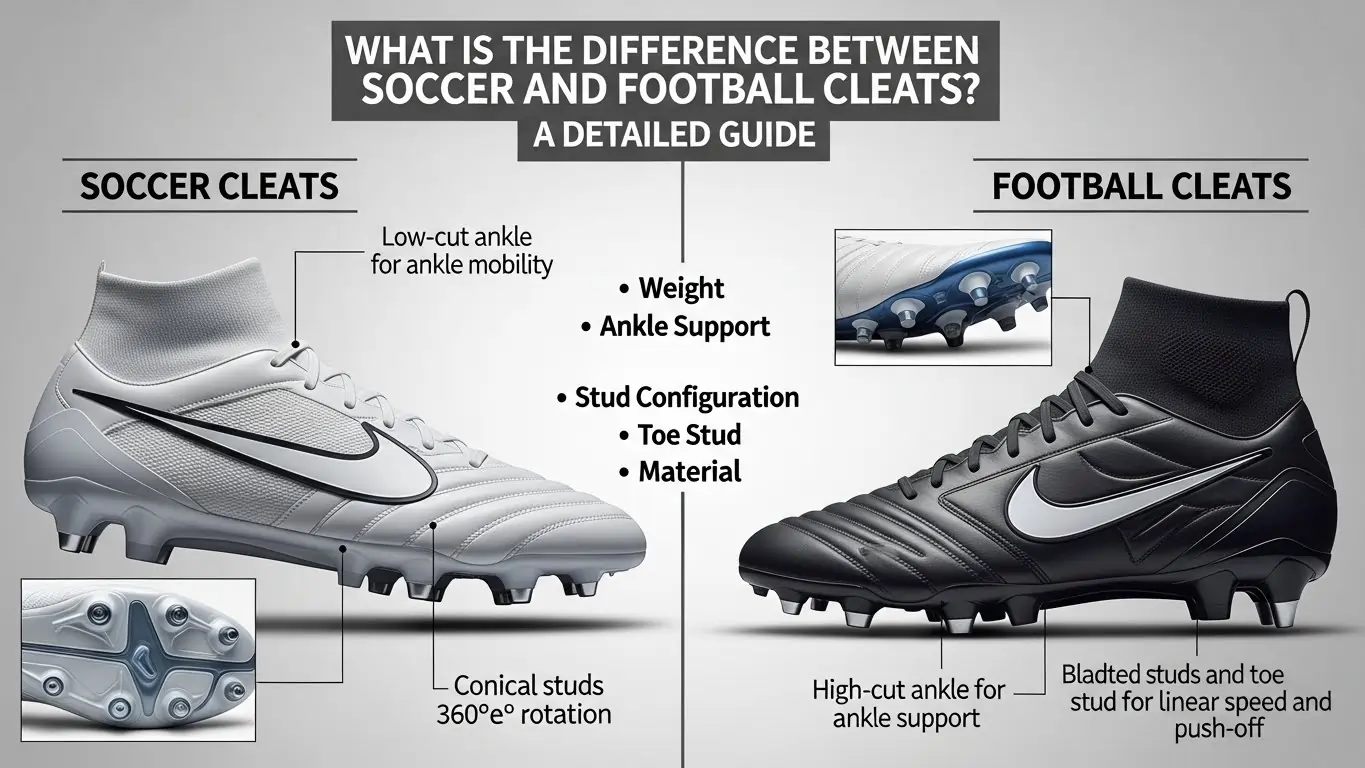
- The “Toe Stud”: Football cleats have a spike at the tip of the toe. Soccer cleats never do.
- Safety Rule: You cannot wear football cleats in a soccer match (it’s illegal).
- Weight: Soccer cleats are lightweight for agility; football cleats are heavier for protection.
- Best Practice: Always buy the specific shoe for your sport to prevent ankle injuries.
The difference between soccer and football cleats goes far beyond appearance; it directly affects performance, comfort, and on-field safety. Many players and parents search for comparisons between these two shoe types because choosing the wrong pair can lead to poor traction or serious injury. You might also wonder if you can swap them for different sports. While both are designed for outdoor grass fields, their stud patterns, ankle support, and weight are engineered for completely different purposes. This guide breaks down every technical detail to help you make the right choice.
What Are Soccer Cleats?
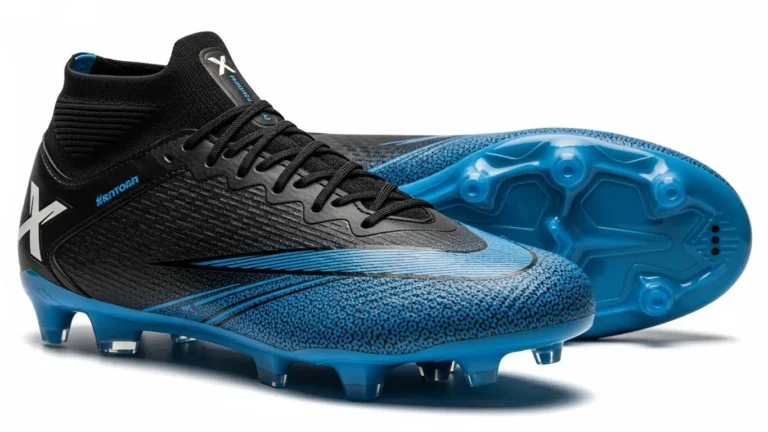
Soccer cleats are engineered specifically for speed, agility, and precise ball control. Since soccer is played entirely with the feet, these shoes must be lightweight and flexible, acting almost like a second skin. Just as a lightweight soccer uniform allows for unrestricted movement, soccer cleats prioritize foot-to-ball contact rather than heavy impact protection. When analyzing the variations between the two styles, you will notice soccer footwear is slimmer and sits lower to the ground to allow for constant running and fluid dribbling.
Typical Features of Soccer Cleats
The design of a soccer cleat is minimalist to ensure nothing gets between the player’s foot and the ball. Key features include:
- No Toe Stud: The most critical safety feature. The toe area is smooth to ensure clean passing and prevent injuries during tackles.
- Lightweight Uppers: Made from thin synthetic or leather materials to enhance touch and reduce fatigue.
- Low Profile: The midsole is minimal to keep the player’s center of gravity low for quick turns.
- Streamlined Silhouette: A narrow fit that feels like a “second skin” for better ball manipulation.
What Are Football Cleats?
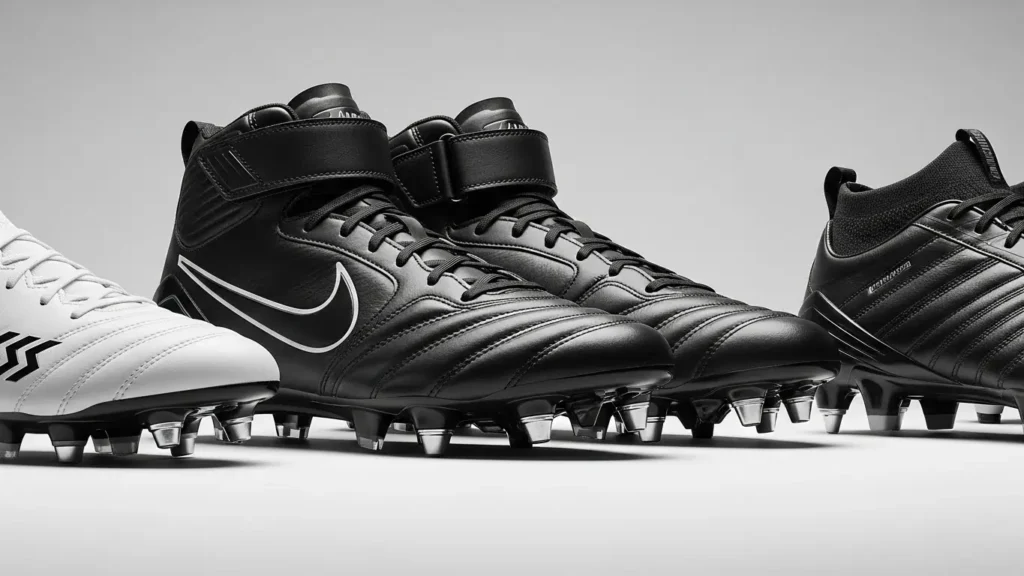
Football cleats are built for power, maximum traction, and physical stability. Because football involves blocking, tackling, and explosive sprinting, these cleats provide a rigid structure to absorb heavy loads. They are designed to complement the heavy protective pads and durable American football uniform worn on game day. In the context of the difference between soccer and football cleats, the football version is noticeably heavier to support the ankle against lateral rolls. They are tools designed for leverage and protection rather than finesse.
Typical Features of Football Cleats
Football footwear prioritizes protection and traction over ball feel. You can identify them by:
- The Toe Spike (Toe Stud): A solitary stud at the very front tip used for digging into the turf during explosive starts.
- Thicker Outsoles: Rigid plates designed to provide stability during pushing and blocking.
- Heavy Padding: Thick upper materials to protect the foot from being stepped on during scrums.
- Ankle Support: Often available in Mid or High-Top cuts to lock the ankle in place.
Studs & Outsoles — The Core Difference
The outsole is where the distinctive design between soccer and football cleats is most visible. Soccer cleats utilize a specific stud dispersion to allow the foot to rotate and pivot freely. In contrast, football cleats use aggressive, static stud layouts designed for linear grip and stopping power. This distinction is vital for safety; using the wrong traction pattern can cause the foot to get “stuck” in the turf, leading to knee injuries. The outsole stiffness also varies, with football plates being much more rigid.
Soccer Cleats Stud Pattern Explained
Soccer cleats feature studs that are evenly spaced across the heel and forefoot, but critically, there is no stud at the very tip of the toe. This absence is intentional for two reasons: safety during tackles and cleaner ball contact. If you examine the stud pattern closely, you will see it is designed to distribute weight evenly. This layout supports the constant direction changes required in soccer, preventing the injury risks associated with the aggressive spikes found in other sports.
Football Cleats Stud Pattern Explained
The most distinct element of a football cleat is the toe stud. This solitary spike at the front center allows linemen and skill players to generate massive forward force from a standstill. However, this same feature makes them dangerous for other sports. In discussions about the difference between soccer and football cleats, this toe stud is the deal-breaker. While it provides the necessary leverage for a 300-pound lineman, it poses a cutting hazard in soccer, which is why it is banned in nearly all soccer leagues.
Surface Types & Recommended Stud Types
Performance depends heavily on matching the cleat to the surface you play on. Using the wrong stud type is a leading cause of non-contact injuries.
- Firm Ground (FG): The standard molded studs designed for natural grass fields.
- Artificial Grass (AG): Shorter, more numerous circular studs designed to prevent “sticking” on turf and saving knees.
- Soft Ground (SG): Metal-tipped studs used on wet, muddy natural grass (common in pro soccer).
- Turf (TF): Small rubber bumps for thin carpet turf; these are not true cleats.
Fit, Comfort & Functional Differences
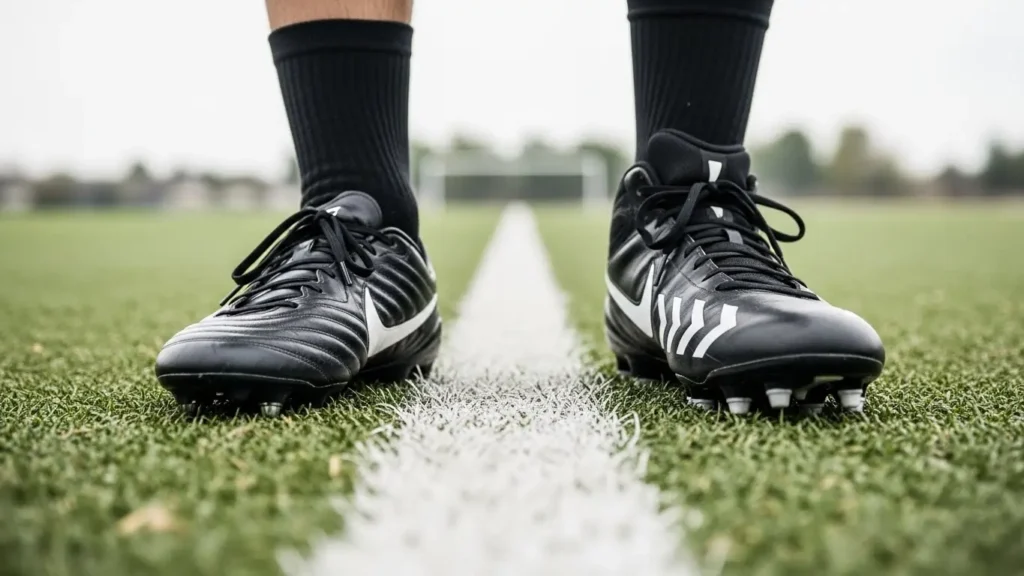
The fit creates a noticeable distinction between the two shoe types. Soccer shoes are designed to fit very snugly—often described as “tight”—to minimize the space between the foot and the ball. Football cleats, conversely, often allow slightly more room to accommodate thicker athletic socks. Players usually switch from their warm-up tracksuits into their cleats right before play, and they immediately notice the difference: football cleats feel bulky and stiff, while soccer cleats feel uncomfortably narrow if they aren’t used to the “second skin” fit.
Ankle Support & Collar Height
Soccer cleats are predominantly low-cut to maximize ankle range of motion for dribbling. While some modern “collar” styles exist, they offer minimal structural support. Football cleats, however, offer genuine variety: low-cuts for speed positions, mid-cuts for hybrids, and high-tops for linemen requiring maximum stability. This structural variance is a key part of the difference between soccer and football cleats. If you have weak ankles, the robust support of a high-top football cleat is unmatched, though unsuited for soccer play.
Weight & Flexibility — Agility vs Protection
Soccer cleats are among the lightest athletic footwear available, prioritizing speed and reducing fatigue over 90 minutes of running. Football cleats are heavier due to the reinforced materials needed for protection. This trade-off represents the battle of agility versus durability. When holding both in your hands, the weight difference is obvious. Soccer cleats must flex with the foot’s natural arch, whereas football cleats must remain rigid to protect the foot from hyperextension during high-impact plays.
Can You Wear Soccer Cleats for Football?
A frequent question is whether soccer cleats work for football. The answer is: sometimes. Kickers and punters often prefer soccer cleats because the smooth toe area offers better control over the ball. However, for positions that require blocking or cutting (like linebackers or running backs), soccer cleats lack the necessary toe traction and foot protection. While not illegal, wearing them puts you at a disadvantage for traction and increases the risk of foot bruising from stepped-on cleats.
Can You Wear Football Cleats for Soccer?
Can you wear football cleats for soccer? The answer is a hard no. The primary reason is the toe stud, which is considered a safety hazard to other players. Referees will check your soles before a match and disqualify you if they see football studs. Furthermore, the bulkiness of football cleats kills your “touch,” making it nearly impossible to dribble or pass accurately. In the breakdown of the difference between soccer and football cleats, this is the strict rule you cannot ignore.
How to Choose the Right Cleats
To choose the correct footwear, start with your primary sport. If you play soccer, look for a snug fit without a toe stud, suitable for your specific field type (grass or turf). If you play football, identify your position—linemen need high-top stability, while receivers might want lower-cut speed cleats. Understanding the technical difference ensures you don’t waste money on gear that will be disallowed by a referee or hinder your performance on the field.
Common Mistakes to Avoid
Don’t get benched before the game starts. Avoid these common purchasing errors:
- Ignoring the Toe Stud: Buying football cleats for soccer will get you disqualified by the referee.
- Wrong Surface Type: Wearing SG (metal studs) on artificial turf is dangerous and often banned.
- Forgetting the Kit: Don’t toss the wrong gear into your kit bag. Always double-check your league rules.
- Sizing Assumptions: A size 10 in Nike Football is not always a size 10 in Adidas Soccer. Always try them on.
Quick Comparison Table
Here is a summary of the difference between soccer and football cleats:
Feature | Soccer Cleats | Football Cleats |
Toe Stud | None (Safety rule) | Yes (For traction) |
Weight | Lightweight | Heavy & Durable |
Ankle Cut | Mostly Low | Low, Mid, High |
Primary Goal | Ball Control | Traction & Support |
Interchangeable? | Limited (Kickers only) | No (Banned in soccer) |
FAQ
- Can you wear football cleats in soccer?
No, it is illegal in most leagues due to the dangerous toe stud. - Can you wear soccer cleats for football?
Yes, mostly for kickers, but they offer less protection and traction for other positions. - What is the main physical difference?
The stud pattern (specifically the toe spike) and the weight of the shoe. - Do football cleats hurt for soccer?
Yes, they are stiffer and heavier, which can cause fatigue and limit ball control.
Conclusion
Ultimately, the difference between soccer and football cleats comes down to the specific demands of each sport. Soccer requires finesse and constant movement, necessitating a light, stud-free toe design. Football demands power and stability, requiring a heavier build with a toe spike. While it might be tempting to save money by buying one pair, the safety risks and performance drawbacks make it unwise. Always choose the specific tool designed for the game you are playing to perform your best.