
What Golf Scoring Terms Mean & How Scoring Really Works
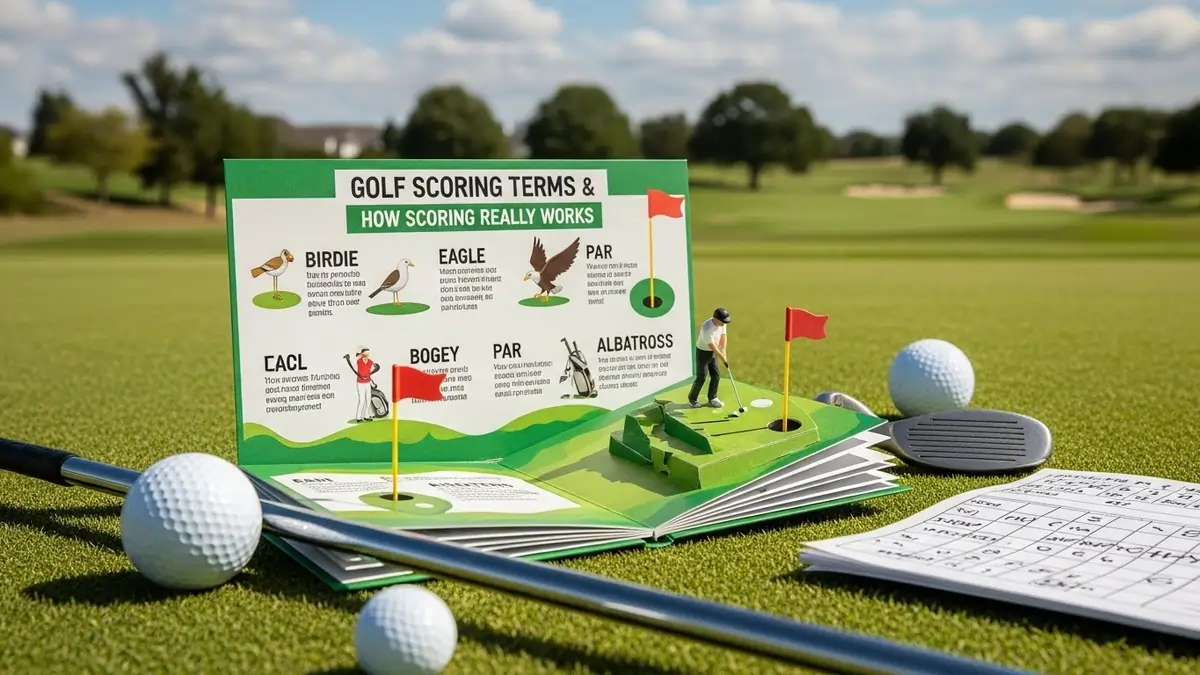
Golf scoring can feel like learning a new language. You hear terms like “Birdie,” “Bogey,” and “Handicap” thrown around the clubhouse, and unlike almost every other sport, a lower score is actually better.
Understanding how scoring works is the first step to enjoying the game (and avoiding embarrassment on the first tee).
At River Shore Clothing, we believe you should look like a pro even if you are still learning the ropes. While we can’t fix your slice, we can explain the rules, and deck you out in the best Performance Polo Shirts for the course.
Here is the ultimate guide to golf scoring terms and how the system really works.
How Golf Scoring Works
In golf, the goal is simple: Complete each hole in as few strokes (shots) as possible.
Every time your club hits the ball, it counts as one stroke. At the end of the round, you add them all up.
- 18 Holes: A standard round consists of 18 separate holes.
- Par Value: Every hole has a “Par,” which is the target score.
- You vs. The Course: Your score is usually compared to Par (e.g., “+4” or “4 over par”) rather than just a raw number.
What Is “Par”?
Par is the number of strokes an expert golfer is expected to take to complete a hole. It is the standard you are aiming for.
- Par 3 (Short): You are expected to hit the green in 1 shot and take 2 putts.
- Par 4 (Medium): Hit the green in 2 shots, take 2 putts.
- Par 5 (Long): Hit the green in 3 shots, take 2 putts.
A standard 18-hole golf course usually has a total Par of 70, 71, or 72.
Golf Scoring Terms Explained
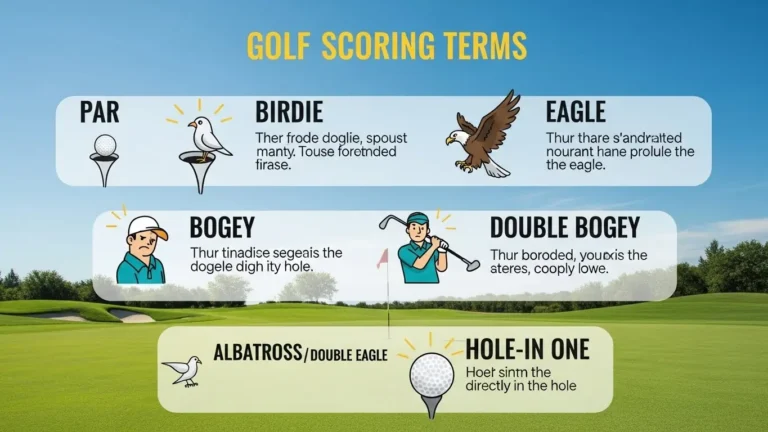
Golfers use a unique vocabulary to describe scores relative to “Par.” Understanding these terms is the first step to feeling comfortable on the course.
Here is exactly what each term means.
1. Par (The Standard)
- Score: Even (E)
- Definition: “Par” is the baseline. If a hole is a “Par 4,” and you take 4 shots, you have “made Par.” It means you played the hole exactly as designed.
2. Birdie (One Under)
- Score: -1
- Definition: A Birdie is a score of one stroke less than Par. It is an excellent score that even pros celebrate.
- Example: You take 3 shots on a Par 4.
3. Eagle (Two Under)
- Score: -2
- Definition: An Eagle is a score of two strokes less than Par. This is very difficult to achieve. It usually happens on Par 5s if you can hit the ball very far, reaching the green in just two shots.
- Example: You take 3 shots on a Par 5.
4. Ace / Hole-in-One
- Score: -3 (usually)
- Definition: The holy grail of golf. This is when your tee shot goes directly into the hole. It typically happens on Par 3s.
- Fun Fact: If you hit a Hole-in-One, tradition dictates you must buy drinks for everyone in the clubhouse!
5. Albatross / Double Eagle (Three Under)
- Score: -3
- Definition: Extremely rare—statistically rarer than a Hole-in-One. This is scoring three strokes under Par on a single hole.
- Example: You take 2 shots on a Par 5.
The “Over Par” Scores (The Struggle)
As a beginner, these are the terms you will use most often. Don’t worry—this is normal!
6. Bogey
- Score: +1
- Definition: A Bogey is one stroke more than Par. For recreational golfers, “Bogey Golf” (averaging a bogey on every hole) is actually a very respectable goal.
- Example: You take 5 shots on a Par 4.
7. Double Bogey
- Score: +2
- Definition: A score of two strokes more than Par.
- Example: You take 6 shots on a Par 4.
8. Triple Bogey (and beyond)
- Score: +3
- Definition: A score of three strokes more than Par. Usually the result of a penalty shot (like hitting the ball into the water).
- River Shore Tip: If you hit a Triple Bogey, shake it off. Adjust your River Shore Hat, take a deep breath, and focus on the next tee shot.
Golf Scoring Cheat Sheet (Summary)
Now that you know the details, here is the quick reference table:
Term | Score to Par | Description |
Ace | -3 | Hole-in-One |
Albatross | -3 | 3 strokes under Par (Very Rare) |
Eagle | -2 | 2 strokes under Par |
Birdie | -1 | 1 stroke under Par |
Par | E | Equal to Par (The Goal) |
Bogey | +1 | 1 stroke over Par |
Double Bogey | +2 | 2 strokes over Par |
Triple Bogey | +3 | 3 strokes over Par |
Stroke Play vs. Match Play
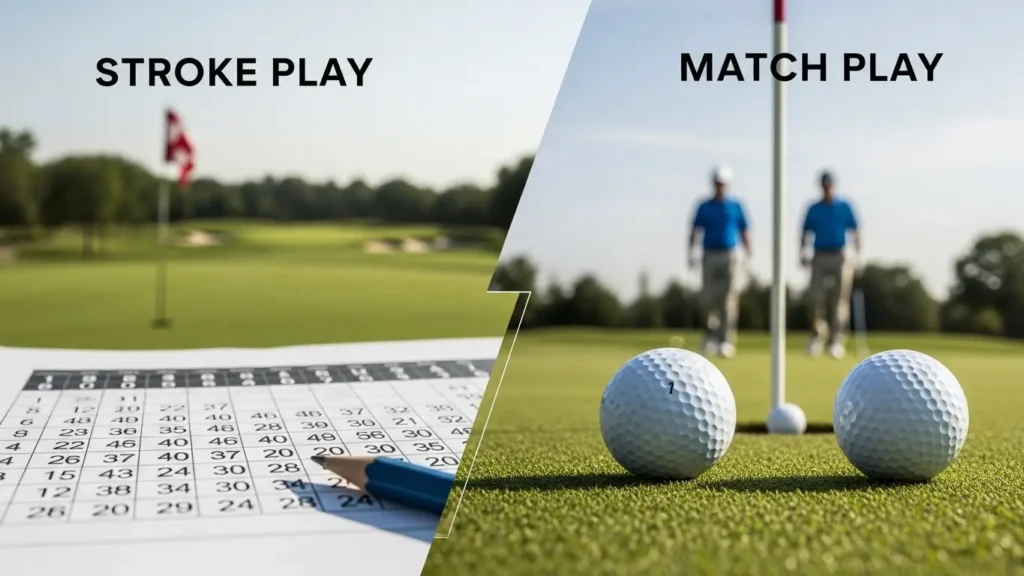
There are two main ways to compete against your friends.
1. Stroke Play (The Standard)
This is what you see on TV. You count every single shot you take over 18 holes. The player with the lowest total number wins.
- Best for: Tracking your personal progress and handicaps.
2. Match Play (The Duel)
You compete hole-by-hole. Total strokes don’t matter; only who wins the individual hole.
- Player A gets a 4. Player B gets a 5.
- Player A wins that hole (1 Up).
- Best for: Friendly rivalries where one bad hole won’t ruin your whole day.
What Is a Golf Handicap?
The “Handicap” is golf’s genius system for fairness. It allows a beginner to compete against a pro.
How It Works:
A handicap is a number that represents your potential playing ability.
- Better Player (Low Handicap): Gives strokes to the other player.
- Newer Player (High Handicap): Receives extra strokes (free shots).
Gross vs. Net Score:
- Gross Score: The actual number of times you hit the ball.
- Net Score: Your Gross Score minus your Handicap.
- Example: You shoot 90, but have a 20 handicap. Your Net Score is 70. If your pro friend shoots 71 with a 0 handicap, you win!
Look the Part: Golf Etiquette & Style
Scoring is important, but in golf, respect and style count just as much. Most courses have a dress code: collared shirts are mandatory, and denim is usually banned.
You don’t need to play like Tiger Woods to look respectable on the tee box.
- The Shirt: A breathable, moisture-wicking Polo is essential. It keeps you cool during a 4-hour round and meets clubhouse dress codes.
- Shop River Shore Polo Shirts (Perfect for the course and the clubhouse).
- The Headwear: A hat is crucial for keeping the sun out of your eyes while reading putts.
- Grab a River Shore Hat to complete the look.
Conclusion
Golf scoring isn’t about perfection, it’s about damage control. The difference between a beginner and a pro isn’t usually the “good” shots; it’s that the pro avoids the “Triple Bogeys.”
Focus on keeping the ball in play, counting your strokes honestly, and enjoying the walk.
Ready to hit the links?
Make sure your outfit is up to par. Check out our Street Wear Collection for premium Polos and T-shirts that transition perfectly from the 18th hole to the car ride home.