
The 3-4 Defense in Football: Complete Guide, Strategy, and Modern Tactics
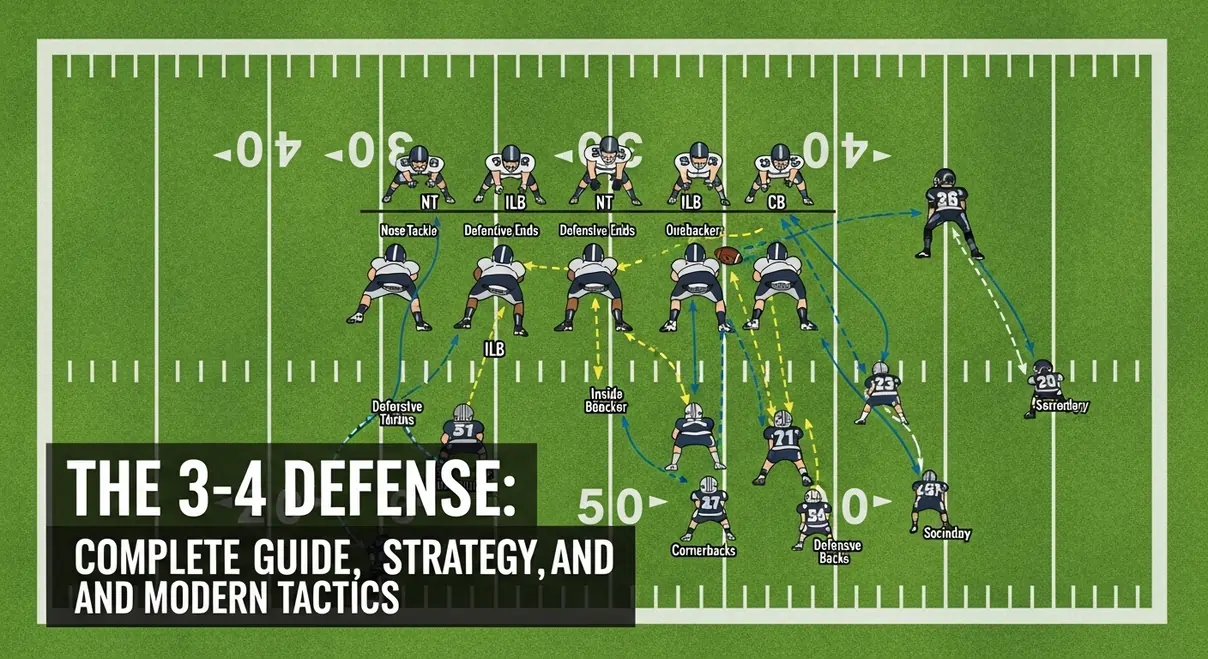
In the high-speed world of modern football, defensive flexibility is the ultimate currency. The 3-4 defense has emerged as the premier solution for defensive coordinators looking to neutralize high-octane spread offenses and complex RPO (Run-Pass Option) systems. This guide explores everything from basic positioning to the advanced “Tite” fronts used in the NFL and college levels today.
History of the 3-4 Defense
The roots of the 3-4 defense can be traced back to Bud Wilkinson at Oklahoma in the 1940s, though it was originally known as the 5-2 defense. As the passing game evolved, the two “end” players on the line were moved back into standing positions to better handle coverage, effectively birthing the modern 3-4. It gained massive NFL popularity in the 1970s and 80s, eventually becoming the gold standard for teams looking to prioritize speed over raw size.
What Is the 3-4 Defense in Football?
The 3-4 defense is a versatile defensive formation in football consisting of three down linemen, four linebackers, and four defensive backs. Its primary purpose is to create unpredictability; by having more linebackers than linemen, the defense can easily disguise blitzes and shift coverage, making it difficult for the quarterback to identify where the pressure is coming from.
Why the 3-4 Defense Is Dominating Modern Football
As we move through 2026, the traditional 4-3 defense (four linemen, three linebackers) is often seen as too “static.”
- Evolution from 4-3 → 3-4: Modern offenses prioritize speed and space. The 3-4 allows defenses to trade a heavy lineman for a versatile linebacker who can either rush the passer or drop into a zone.
- Adaptation vs. Spread & RPO: With RPOs dominating modern playbooks, the 3-4 provides the “hybrid” players necessary to play the run and the pass simultaneously.
- NFL + College Usage: Top-tier programs and NFL franchises like the Steelers and various Saban-inspired college systems use the 3-4 to maintain an authority boost on the field, forcing offenses to react to them rather than the other way around.
3-4 Defense Formation Explained
The “front three” are the unsung heroes of this scheme.
- 0-Tech Nose Tackle (The Space Eater): Positioned directly over the center, the Nose Tackle’s job is to occupy two blockers, freeing up the linebackers to make tackles.
- 5-Tech Ends: These players align on the outside shoulder of the offensive tackles. They must be strong enough to hold the edge but athletic enough to collapse the pocket.
- Outside Linebackers (OLB): These are edge rush + coverage hybrids. In a 3-4, the OLBs are often the primary pass rushers.
- Inside Linebackers (Mike / Will / Sam): The “Mike” (Middle) and “Will” (Weakside) are the heart of the defense, responsible for “downhill” run stuffing and intermediate zone coverage.
- 2 Safeties + 2 Corners: Usually operating in a “two-high” look, this provides coverage flexibility, allowing the defense to rotate into Cover 3 or stay in Quarters.
Key Principles of the 3-4 Defense
1-Gap vs. 2-Gap System
In a 2-gap system, linemen are responsible for the holes on both sides of the blocker. In a 1-gap system, they shoot a specific hole aggressively. Modern 3-4 teams often use a “hybrid” approach to keep offenses guessing.
Gap Control & Run Defense
The 3-4 relies on “clogging the pipes.” If the front three can control their gaps, the four linebackers are left “clean” to fly to the ball and stop the run for minimal gain.
Pre-Snap Disguise Strategy
Because the fourth rusher can come from anywhere (the left OLB, right OLB, or even an ILB), the quarterback rarely knows the true “protection side” until the ball is snapped.
3-4 Defense vs. 4-3 Defense
Element | 3-4 Defense | 4-3 Defense |
Structure | 3 Linemen / 4 Linebackers | 4 Linemen / 3 Linebackers |
Flexibility | High (Hybrid players) | Lower (Static roles) |
Run Defense | Relies on “Space Eating” NT | Relies on Penetration |
Pass Rush | Disguised / Multiple angles | Front 4 consistent pressure |
Best Use Case | Versatile, fast rosters | Physical, dominant D-Lines |
Strengths of the 3-4 Defense
- Multiple Blitz Options: You can bring pressure from any of the four linebacker spots.
- Better Disguise: Difficult for QBs to read the “hot” receiver pre-snap.
- More Speed on Field: Replacing a 300lb tackle with a 240lb linebacker increases overall team speed.
- Adaptability: Easily transitions into “Nickel” or “Dime” packages.
Weaknesses of the 3-4 Defense
- Needs Elite Nose Tackle: Without a dominant NT to take on double teams, the scheme crumbles.
- Weak vs. Power Run: Can be bullied by heavy “I-Formation” power schemes.
- Complexity: Requires high-IQ players who understand complex football defensive schemes.
Common 3-4 Defense Blitz Packages
Zone Blitz
The defensive end drops into coverage while a linebacker blitzes from the opposite side. This “exchanges” responsibilities to confuse the QB’s read.
Crossfire Blitz
Two inside linebackers cross paths as they blitz through the “A” gaps, aiming to create a free lane to the quarterback.
Edge Blitz
Both Outside Linebackers rush simultaneously, creating a “pincer” move that forces the QB to step up into the waiting arms of the Defensive Ends.
Coverage Schemes in the 3-4 Defense
- Cover 2: Two deep safeties with five underneath defenders.
- Cover 4 (Quarters): Four deep defenders, excellent for stopping the modern vertical passing game.
- Cover 3 Rotation: One safety drops into the middle “hole” to create a three-deep look, often used to bait QBs into interceptions.
Advanced 3-4 Defense Variations
Tite Front (vs. RPO)
Popularized in recent years, the Tite Front uses “4i” techniques (lining up on the inside shoulder of the tackles) to take away the interior gaps used in RPO and inside zone runs.
Hybrid 3-4 Defense
A “multiple” front where the defense can look like a 3-4 one play and a 4-3 the next by moving a linebacker into a “stand-up” end position.
How Offenses Attack the 3-4 Defense
- Spread Formations: Forcing the OLBs to cover wide receivers in space.
- Trips / Motion Confusion: Using motion to force the linebackers to communicate and shift pre-snap.
- Power Run Schemes: Using a fullback to create a “plus one” advantage in the run game.
How to Beat the 3-4 Defense
If you are an offensive coordinator, here is your cheat sheet to beating the 3-4:
- Attack the Weak Box: Use “11 personnel” to pull linebackers out of the box.
- Use Motion: Move the TE to see if the OLB follows, revealing the coverage.
- Stretch Runs: Force the heavy defensive ends to run sideline-to-sideline.
- Quick Passes: Use slants and bubbles to negate the blitz.
Best Players & Teams Using the 3-4 Defense
Historically, Bill Belichick and Nick Saban are the godfathers of the modern 3-4. The Pittsburgh Steelers have used this system with legendary success, producing “Edge” legends like T.J. Watt.
When Should You Use a 3-4 Defense?
- Team Size & Skill: Use it if you lack four elite defensive linemen but have plenty of fast, aggressive linebackers.
- Coaching Level: While complex for high school, it is the gold standard for college and pro levels where linebacker roles are more specialized.
3-4 Defense Alignment Variations
- 3-4 Over: The front shifts toward the “strong” side (tight end side).
- 3-4 Under: The front shifts away from the tight end.
- Tite Front: The defensive ends move inside to the “B” gaps.
FAQs
What is a 3-4 defense?
It is a defensive formation using 3 down linemen and 4 linebackers. It is known for its versatility and ability to disguise blitzes.
Is 3-4 better than 4-3?
Neither is inherently “better,” but the 3-4 is generally better against modern, pass-heavy “Spread” offenses, while the 4-3 is often more stout against traditional power running.
What is a nose tackle?
The Nose Tackle (NT) is the central defensive lineman who lines up over the offensive center. Their primary role is to “eat” double teams and stop interior runs.
Why is it called 3-4 defense?
The name refers to the personnel on the field: 3 Linemen and 4 Linebackers.
How to beat 3-4 defense?
Attack the edges with outside runs and use quick, short passes to exploit the space vacated by blitzing linebackers.
Conclusion
The 3-4 defense is more than just a formation; it is a philosophy of adaptability. As offenses continue to innovate with speed and RPOs, the 3-4 provides the structural integrity and disguise needed to stay one step ahead. Whether you are a coach looking to implement a new system or a fan trying to understand the “chess match” on Sunday, mastering the 3-4 is essential to understanding modern football.